Unfortunately, there is no internet in my home now, so my posts will probably be more infrequent. I'm in a cafe now with my boyfriend, an iced cafe mocha, and a chocolate mousse cake. My taste buds are so happy!
I have yet to take pictures of the apartment I now share with my boyfriend and his mother, but I will eventually. It keeps slipping my mind. Anyway, we're very comfortable, although the language barrier makes me very shy around his mother. It's also the cause of many laughs. For instance, we were talking about how people stare at me all the time in Korea, especially here in the countryside city of Andong, and she asked if people will stare at my boyfriend when we go to America. I explained, "미국에서는 외계인이 많잖아요" which means "As you know, [unlike in Korea] in America, there are many aliens." The word "외계인" (wae-gae-een; alien) sounds like the word "외국인" (wae-goog-een; foreigner) to me, so sometimes I make that mistake. So, rather than assuring her that her son would blend in in America much better than I do in Korea, I assured her of the common knowledge that there is an ongoing extra-terrestrial invasion in my home country. Mostly, I just listen, nod, and look confused most of the time. My boyfriend's translation skills are rapidly improving, as I'm sure mine will in America.
Speaking of translation skills, as I mentioned before, my father came to Korea on a business trip a while ago. My boyfriend and I took the subway in Seoul to the express bus terminal, from which we took a bus to Andong. Once we arrived with all of my earthly belongings in tow, we rested a while and then left for Ulsan late at night. We arrived in the wee hours of the morning, and my friend 성동 (Sungdong) picked us up from the train station and took us to our friend Reza's house. We all talked for a while, then 성동 (Sungdong) went home, Reza made up a bed of blankets on the floor for my boyfriend and I, and we all slept. In the (later) morning, we woke up and Reza walked us to the bus station and gave us directions to my father's hotel.
Walking with my so very American father and my so very Korean boyfriend in Korea was... strange for sure. Not bad, just really, really, somehow intrinsically wrong. It would be even stranger if we were in France, I suppose, and then I would have a lot more translating to do because I'm the only one of the three of us who knows French. I'm sure there are a hundred million ways it could have been stranger, but I can't explain how odd it felt. As I expected, it was a jumbled collision of two worlds. It was so strange to hear my father trying to say Korean words and sounding so American, whereas in the past seven months I have begun to forget that I'm not Korean. It was so strange to have a melt-in-your-mouth filet mignon at Outback Steakhouse for lunch, speaking almost exclusively English with a person I've known my entire life in America, then stepping outside to be reminded that no, this is not America, this is Korea. It was strange to be so excited that my father had brought me American deodorant (I have yet to find deodorant in Korea I don't have to re-apply 5 times a day) and s'mores ingredients, whereas a year ago those things were just everyday items.
Now I have to sidetrack about s'mores. When we brought the marshmallows, Hershey's chocolate, and graham crackers back to Andong and shared them with my boyfriend's mother, she asked if they were expensive. I laughed, then realized that this simple food I think of as a cheap, fun part of a normal summer or autumn was a novelty to my boyfriend and his mother. Actually, my boyfriend loves s'mores, and his mother likes them, but his little brother hates them. I never imagined someone not liking s'mores, except one of my best friends, Anna, who abhors chocolate. Still, I'm sure she likes marshmallows and graham crackers. There was so much ado about s'mores in the apartment, it made me understand how I'm perceived here sometimes. In Ulsan, we walked by a cart/booth/kiosk (very common in Korea) where a man was selling fish. But it wasn't fish- it was bread shaped like fish. I was thinking, "it's shaped like a fish, so it must be fish-flavored." I've never been a fan of fish, so I was very reluctant to try it until I was informed that it had nothing to do with seafood. My dad bought one for each of us, and as soon as I bit into it apprehensively, I was elated. It was delicious! Hot, soft, sweet bread with soft red (sweet) beans inside. I love soft food, and I love sweet flavors. It was absolutely savory, and even as I'm writing this now, I'm craving another. And how clever- bread shaped like a fish! I've seen ice cream shaped like a fish, but that was the first fish-shaped bread I tasted. My boyfriend was so amused. That food is a traditional autumn food in Korea, and each one costs 1000 won, which with the exchange rate the way it is is less than $1. It's just like s'mores for my boyfriend and his mother.
After lunch in Ulsan, we walked around, alternating tour-guide roles. My father has been to Ulsan maybe five times now on business trips, and always stays in the same hotel. Like me, he's an explorer, taking the first opportunity in a new place to walk around and get the lay of the land, so he knew a bit about the area. My boyfriend is Korean, as you all know by know, so he knows more about Korea than my father and I do, and is obviously fluent in Korean. I'm between worlds; at this point I know a lot about Korea (not nearly half, I'm sure, but a lot), and I have an American perspective, so I knew what things about Korea would be the most novel for my father, and could draw interesting similarities and contrasts between cultures, much like I try to do here in my blog.
In terms of language, my boyfriend can understand the gist of English conversation better than I can understand Korean conversation, because his English vocabulary is larger than my Korean vocabulary. But, I still had to do some translating. However, as I just mentioned, my Korean vocabulary is somewhat lacking. So what I did was translate from English to couple-ish. That's my new name for the English, Korean, Konglish (Korean directly translated into English), and Youngeul (my name for the reverse of Konglish) that my boyfriend and I mix together into our own language. My boyfriend does the same (Korean -> couple-ish) for me when we talk to Koreans or watch TV.
Speaking Korean, around my father was really strange. When I left America, I had one semester of Korean class behind me, so I could read and write and say simple present-tense sentences. Now I'm using more complicated grammar structures by habit, and my vocabulary of everyday words has expanded to an almost fluent level. So, to the untrained ear, it can sound like I'm fluent in Korean even though I sound like a child to Koreans. Where I'm going with this is that Here I am in Korea, chatting away in Korean with my Korean boyfriend and then shifting to English with my American father in America-wait no- still in Korea!
Anyway, I have a lot of things to take care of, so I will write more later, as always. I hope this satisfied curiosity for a while. :)
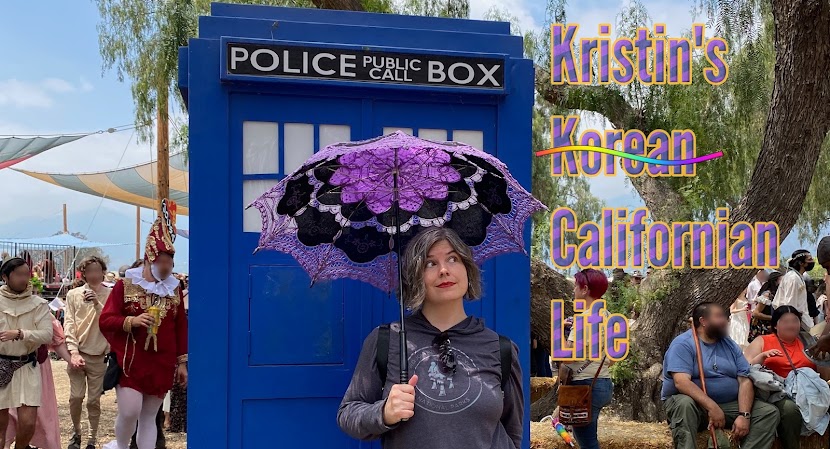
On March 26, 2009, I left my life in America and moved to South Korea. I put my worldly possessions into two suitcases and a backpack and got on a plane. On December 8, 2012, I returned not to my hometown of Detroit, but to Silicon Valley, California, where I married an Indian engineer. In 2020, I divorced and moved to southern California. In this blog are my successes, failures, and observations of life in different cultures.
Friday, October 23, 2009


Wednesday, October 7, 2009
Family in Korea
I'm moving to the countryside this weekend. My boyfriend's mother lives in 안동 (Andong), which is about four hours away from Seoul by bus or train. You might remember from an earlier post that my boyfriend and I visited there together a while ago. We will move there together this Saturday. In the next couple of weeks, we'll figure out how to get him on the same planes as I am to America on Christmas Day.
My father will be in 울산 (Ulsan) this weekend on business. You might remember from an even earlier post that I have a couple of friends there and went to visit them for a weekend over the summer. It works out quite nicely so that my boyfriend and I can go there Saturday night or Sunday and see my father and my friends Reza and 성동 (Sungdong). We'll be a bit tired after this busy weekend, but we can take some down time after moving in to rest.
So there's the cold version of my moving and seeing my father this weekend.
Here are my thoughts about it.
I won't have to pay rent, just earn enough to pay off the credit card balance my Japan trip racked up and to grocery shop and travel a little bit. My boyfriend will also be working. That means I don't have to worry about rent for a whole two months. I love that. It's so stressful working and studying and always traveling here and there to meet friends and students. Also, one big stress in my relationship with my boyfriend has been that we both wake around noonish (me usually even later) and work in the evenings, and we live an hour and a half away from each other. Somehow we still manage to see each other every weekend and usually once or twice during the week, but the difficulty of organizing our lives takes its toll. In Andong, even if we work our butts off, we will come home to each other. We can cook together, watch TV before bed together, even clean together. I really love him. People are starting to ask if we're getting married (Korean society is more conservative than American society) and it doesn't freak me out. I just say, "I hope so, much later."
Anyway, I'm terrible at living alone. I love the freedom, but at the same time I loathe it.
I love that I can eat anything I want anytime I want to, but I hate eating alone and I'll never cook delicious, healthy food for myself. I live mostly on ramen, 삼각김밥 (convenience store triangle sushi rolls), and egg fried rice unless I go out. Living with someone else encourages me to have a normal eating and sleeping schedule. Also, because my boyfriend and I both enjoy cooking, we can rotate meals and have motivation to make more and more delicious food.
I love that I don't have to study or do my homework, but I hate that it's so easy to forget about my online courses that I'm falling dreadfully behind. I hate myself for it, but as usual, I'm much better at wasting my time doing nothing and feeling busy anyway than I am at studying. I think I'm allergic to studying. My boyfriend has promised to make me study, and even to "take" my classes with me, like Physics, my worst subject. When I lived with other students, seeing them study made me feel guilty for not studying and I got my homework done and went to class for the most part. Living with my mother was even more conducive to study because she's got the motherly nagging thing down. I guess I never thanked her for that. Thank you. :) Another problem now is that online classes don't feel real to me, whereas sitting in a classroom however many times a week makes me feel like they're obligatory and therefore I'm more likely to complete assignments because I'm accountable to a real person. Basically, I need to be held accountable to study. Messed up, I know. I just prefer learning via the sponge method to making a conscious effort. I also learn better that way, anyway. For instance, I've learned Korean much faster by making friends and living in Korea, although I don't really actively study aside from curiosity, than I did taking a class which I mostly ignored. I willingly admit that this is a mental problem I have, and that I'm not fighting it as actively as I could be. Although I know my procrastination and detachment is a completely ridiculous issue that exists only in my head and that I could change it if I tried. But on the other hand, I can't seem to find a way to light that fire under my own ass and get my life in gear. I'm lazy and a hard worker at the same time, but my priorities are not in order. Living with someone else, especially someone who loves me and cares about my future and is willing to push me toward it, helps me get my life in order.
I love that I can watch whatever I want on TV without thinking about what anyone else may or may not like. I hate that the TV is my only friend. It's lonely. Even if I talk to five people on MSN while the TV is running so there are voices in my room; even if I think about the fact that almost 100 people also live in 2m x 2m rooms on my floor... I'm so lonely living alone. I'll gladly give up my freedom of TV programming in order to have a warm body on the couch next to me. Especially if that person I'm sharing the couch with is cuddly and lovable.
Anyway, about seeing my dad... it's strange. Now my two worlds are colliding. My Korean friends whom I happened to become friends with in America and also met in Korea don't constitute a collision of worlds in my head because they've always been associated with Korea. My father is rooted and anchored in America. The only time I've seen him in another country, although he goes on many international business trips, was when we went on a family trip to Germany and England about 15 years ago. Being in Korea, I've left America in a corner and concentrated on my life here, my new start. But I only have two and a half months left before returning to America for six months. It's really helping to pound that reality back into my head. I'm on cloud nine, but I have to find a balance between that and the real world. And, I have less than a year to choose a country, a career, allegiances, direction, etc.. I'm pretty sure I want to stay in Korea, but for how long? What comes next? I could imagine myself living in either Korea or America, but having them collide makes it more clear that they are separate by nature and that I can only have one at a time.
Thinking way far ahead, I would prefer that my children grow up in American schools, because the Korean educational system has issues I've already discussed in terms of the extracurricular network of academies Korean children are expected to spend all of their spare time in. Also, attending English-speaking schools will increase their chances in global job markets, because Korean is not a global language. But, at the same time, I want my children to have Korean culture and to love Korea. This is, of course, assuming I marry a Korean man, perhaps even my current boyfriend. Another important factor concerning my future children is that I obviously have wanderlust, which is either genetic or a result of moving so many times during my childhood. I think it is both a gift and a curse. I want my children to have a concrete idea of a place they can call home, but at the same time I don't want them to be so anchored to home that they can't break free and find their own paths. At what point to I ignore my wanderlust so that I don't damage my children's lives? To what extent to I follow it so that I instill cultural acceptance, social skills, and independence in them? Being forced to start over in a new school is a painful but rewarding process. How do I know how much is too much? Why am I worrying about children when I don't even know where I'll live and what I'll be doing next year? Am I growing up? Haha.
My father will be in 울산 (Ulsan) this weekend on business. You might remember from an even earlier post that I have a couple of friends there and went to visit them for a weekend over the summer. It works out quite nicely so that my boyfriend and I can go there Saturday night or Sunday and see my father and my friends Reza and 성동 (Sungdong). We'll be a bit tired after this busy weekend, but we can take some down time after moving in to rest.
So there's the cold version of my moving and seeing my father this weekend.
Here are my thoughts about it.
I won't have to pay rent, just earn enough to pay off the credit card balance my Japan trip racked up and to grocery shop and travel a little bit. My boyfriend will also be working. That means I don't have to worry about rent for a whole two months. I love that. It's so stressful working and studying and always traveling here and there to meet friends and students. Also, one big stress in my relationship with my boyfriend has been that we both wake around noonish (me usually even later) and work in the evenings, and we live an hour and a half away from each other. Somehow we still manage to see each other every weekend and usually once or twice during the week, but the difficulty of organizing our lives takes its toll. In Andong, even if we work our butts off, we will come home to each other. We can cook together, watch TV before bed together, even clean together. I really love him. People are starting to ask if we're getting married (Korean society is more conservative than American society) and it doesn't freak me out. I just say, "I hope so, much later."
Anyway, I'm terrible at living alone. I love the freedom, but at the same time I loathe it.
I love that I can eat anything I want anytime I want to, but I hate eating alone and I'll never cook delicious, healthy food for myself. I live mostly on ramen, 삼각김밥 (convenience store triangle sushi rolls), and egg fried rice unless I go out. Living with someone else encourages me to have a normal eating and sleeping schedule. Also, because my boyfriend and I both enjoy cooking, we can rotate meals and have motivation to make more and more delicious food.
I love that I don't have to study or do my homework, but I hate that it's so easy to forget about my online courses that I'm falling dreadfully behind. I hate myself for it, but as usual, I'm much better at wasting my time doing nothing and feeling busy anyway than I am at studying. I think I'm allergic to studying. My boyfriend has promised to make me study, and even to "take" my classes with me, like Physics, my worst subject. When I lived with other students, seeing them study made me feel guilty for not studying and I got my homework done and went to class for the most part. Living with my mother was even more conducive to study because she's got the motherly nagging thing down. I guess I never thanked her for that. Thank you. :) Another problem now is that online classes don't feel real to me, whereas sitting in a classroom however many times a week makes me feel like they're obligatory and therefore I'm more likely to complete assignments because I'm accountable to a real person. Basically, I need to be held accountable to study. Messed up, I know. I just prefer learning via the sponge method to making a conscious effort. I also learn better that way, anyway. For instance, I've learned Korean much faster by making friends and living in Korea, although I don't really actively study aside from curiosity, than I did taking a class which I mostly ignored. I willingly admit that this is a mental problem I have, and that I'm not fighting it as actively as I could be. Although I know my procrastination and detachment is a completely ridiculous issue that exists only in my head and that I could change it if I tried. But on the other hand, I can't seem to find a way to light that fire under my own ass and get my life in gear. I'm lazy and a hard worker at the same time, but my priorities are not in order. Living with someone else, especially someone who loves me and cares about my future and is willing to push me toward it, helps me get my life in order.
I love that I can watch whatever I want on TV without thinking about what anyone else may or may not like. I hate that the TV is my only friend. It's lonely. Even if I talk to five people on MSN while the TV is running so there are voices in my room; even if I think about the fact that almost 100 people also live in 2m x 2m rooms on my floor... I'm so lonely living alone. I'll gladly give up my freedom of TV programming in order to have a warm body on the couch next to me. Especially if that person I'm sharing the couch with is cuddly and lovable.
Anyway, about seeing my dad... it's strange. Now my two worlds are colliding. My Korean friends whom I happened to become friends with in America and also met in Korea don't constitute a collision of worlds in my head because they've always been associated with Korea. My father is rooted and anchored in America. The only time I've seen him in another country, although he goes on many international business trips, was when we went on a family trip to Germany and England about 15 years ago. Being in Korea, I've left America in a corner and concentrated on my life here, my new start. But I only have two and a half months left before returning to America for six months. It's really helping to pound that reality back into my head. I'm on cloud nine, but I have to find a balance between that and the real world. And, I have less than a year to choose a country, a career, allegiances, direction, etc.. I'm pretty sure I want to stay in Korea, but for how long? What comes next? I could imagine myself living in either Korea or America, but having them collide makes it more clear that they are separate by nature and that I can only have one at a time.
Thinking way far ahead, I would prefer that my children grow up in American schools, because the Korean educational system has issues I've already discussed in terms of the extracurricular network of academies Korean children are expected to spend all of their spare time in. Also, attending English-speaking schools will increase their chances in global job markets, because Korean is not a global language. But, at the same time, I want my children to have Korean culture and to love Korea. This is, of course, assuming I marry a Korean man, perhaps even my current boyfriend. Another important factor concerning my future children is that I obviously have wanderlust, which is either genetic or a result of moving so many times during my childhood. I think it is both a gift and a curse. I want my children to have a concrete idea of a place they can call home, but at the same time I don't want them to be so anchored to home that they can't break free and find their own paths. At what point to I ignore my wanderlust so that I don't damage my children's lives? To what extent to I follow it so that I instill cultural acceptance, social skills, and independence in them? Being forced to start over in a new school is a painful but rewarding process. How do I know how much is too much? Why am I worrying about children when I don't even know where I'll live and what I'll be doing next year? Am I growing up? Haha.
Thursday, October 1, 2009
Japan Trip #2 and More
Because my multiple-entry C-3 Korean visa allows me to stay in Korea for 90 days after each entry, I had to leave for the second time last week. I lined up the 90 days perfectly so I left the day my visa expired and will leave again the day it expires, December 25 Christmas Day. That meant I was in Fukuoka from Tuesday September 22 to Saturday the 26th. The 27th marked exactly 6 months that I've lived in Korea. Half a year!!
Anyway, I didn't have much money, and I went to Japan alone, and I find Japan rather creepy, so I mostly stayed in my room eating convenience store food, reading textbooks, and watching Korean movies on my computer. I also find Japan frustrating because while I can understand more Japanese than I can Korean, I've been in Korea so long that I think in Korean and can't remember Japanese vocabulary when I'm trying to speak. Also, I can't read Japanese well because they use so many kanji, Chinese symbols. In Korea, I can read just fine. I'm a little slow, and I often don't know the meaning, but I can look up the words in my cell phone's English-Korean dictionary. Anyway, I accidentally spoke Korean to a few people, then corrected myself in Japanese, then asked if they could speak English or French.... it was pretty ridiculous.
Just after I checked into my hotel room, I asked the front desk if they had power converters for American or Korean plugs. They didn't. I asked where I could buy them, and was given a map and directions to a store. I went there, but I felt like I had gone too far and was getting lost. It was dark, although not very late, and everything was unfamiliar. All of the people looked different... I'm used to Koreans now, and I'm used to Americans and the American mix of ethnicities, but Japanese people look different and are, on average, significantly shorter. In Korea, I'm still shorter than the average man if I don't wear high heels. In Japan, I think I might be taller than the average man! When I finally got to the store, there were so many signs and arrows and people and everything was Japanese. I was so lost. I asked the information counter, showing my laptop charger and converter for Korean outlets, and used what Japanese I could throw together. She directed me to the second floor, where I found one for my American computer, but not one for my Korean cell phone. So I asked an associate, who walked with me to the third floor and asked someone else, who led us to the right section. Eventually there were three guys who worked there all trying to understand that I wanted a converter for BOTH American AND Korean plugs because I'm from America but I live in Korea so I have something important to plug in from each country. Finally, after about 15 minutes, one of them presented me with a converter for my three-pronged computer plug and my Korean plug- both in one! It's great, because I was expecting to have to buy two different ones. I was very happy that despite the language barrier, I ended up with something better than I expected. As I paid, the cashier apologized profusely and thanked me way too much. I know this is just Japanese culture, but I'm almost offended by the excessive apologetic atmosphere in Japan, as if the people are patronizing and self-depreciating at the same time. If the same situation occurred in Korea, the worker would apologize once- maybe twice- for taking so long, thank me for buying something, and ask me to come again. Same as in America. I guess I have a culture bias that favors Korean culture based on the things I like about American culture.
Let me elaborate on that whole culture bias thing. In America, being white from some unknown mix of European countries and either Native American or gypsy, I always thought I had no culture. My friends whose parents or grandparents came from other countries had culture: Chinese, Egyptian, Korean, German, Italian, etc. My African American friends had culture. My half African American, half German friend hit the culture jackpot (I love you E.B. haha)! So how is it that I can recognize in myself a culture bias when I am devoid of culture? Well, I'm like a goldfish in a tank with many other goldfish and a few different exotic fish. I can see that the exotic fish are different, but I never think about the water I'm in or about the other goldfish as being distinctive. Now I'm the goldfish in a bowl full of one kind of "exotic" fish. Who's exotic now? I'm still figuring out just what it means to me to be a goldfish, and at the same time, I'm changing my scales a bit to adjust to my new surroundings. Why do I like Korean fish better than Japanese fish? That's complicated.
In American culture, people are often very bubbly and friendly to strangers, which sometimes even puts foreigners on edge. Japanese are not at all bubbly and friendly to strangers; instead, they are distant, polite, and cordial. An American will tell you more than you ever need to know about their life if you happen to be sitting next to him/her on a plane. A Japanese person will tell you the basic facts and then get back to his/her book or newspaper. Koreans are in the middle. While Americans can be a little rude, and Japanese cold, Koreans are genuinely kind, or just too shy to say anything at all. Of course, these are generalizations, and therefore only apply to maybe 60-80% of people from each country, and I have by no means met everyone from each country. Even within each country, people vary according to regional culture. San Fransisco, Detroit, New Orleans, and Washington D.C. are all vastly different, for instance.
In American culture, everyone pays equally for everything. If two friends go out together, they either split the check or one person pays and the other person owes him/her the same thing later. In America, I always had to remember how much I owed this friend, how much that friend owed me, etc. It's very confusing and stressful. In Korea, the older person pays. Or, the person with more money. That's it. Now, the younger generation is embracing the idea of "Dutch pay" so groups of friends often split the price to alleviate the burden on one person. Or, one person buys dinner and another pays for drinks at the bar and another pays for a singing room, because you don't just do one thing when you hang out in Korea. I don't know the custom in Japan, but I like the one in Korea. Partly because I'm just about the youngest of my friends, and partly because it just makes sense. Right now, I'm still a college student and can't get my career off the ground until I graduate. Therefore, I don't have the opportunity to make a lot of money. A year or two from now, I'll have a stable job, a stable income, and a home, and I'll have more money to spare to buy dinner for my younger friends. I love when people buy things for me, and I love buying things for people. It's the Christmas effect. I know that when someone pays for me, they enjoy the smile on my face, and when I pay for someone else, I enjoy the smile on his or her face.
In America, we drive on the right side of the road. Korea, too. In Japan, it's the left side. So confusing to me when crossing the street. I guess in that respect, British people would prefer Japan.
In America and Japan, signs, commercials, and other everyday parts of the man-made environment are usually in the no-funny-business style. Simple, block print. Easy to read, mildly eye-catching, professional. Here, "under construction" signs have adorable pictures of construction workers who look like children. Restaurants often have cute illustrations of smiling pigs or fish on their signs. Part-time working girls in cute outfits do silly dances on stages on the sidewalk to attract customers. My boyfriend wars socks with cartoon depictions of G-Dragon (a popular singer), Jack Skeleton, and 윤지후 (Yoon Ji-hoo) from 꽃보다남자 (Boys before Flowers, my favorite popular Korean drama) and that's totally not gay here. T-shirts are cuter, the text on signs is adorable, the commercial jingles are catchier in a cute way, even office supplies and decorations in legitimately professional institutions are often cute. Korea is so cute, it makes me smile every day. Japan and America are mildly depressing in their efforts to look more professional than the competition.
Just a personal preference: I like the voices and melodies of Korean pop better than any other country's pop I've heard. Of course, I love 70% of music, and couldn't live without listening to and playing music on a regular basis, so that's not really a huge factor in why I prefer Korea.
Because of the devastation following the brutal Japanese occupation of Korea from 1910-1946 (Japan was forced to relinquish Korea after being defeated in WWII) and the exhausting Korean war (which never technically ended, resulting in the shaky situation surrounding the DMZ or JSA) from 1950 to the armistice in 1953, almost everything in Korea was built in the past 50ish years. On top of that, Korea has a very trend-based society, valuing the newest and rejecting the oldest (unless it's the historically meaningful brand of old). So, the buildings are quite modern and clean, usually white or light gray or completely walled by windows. The main streets are wide, as well as the newer subway stations. Japan, on the other hand, seems to me to be in the American 70's style of dark colors, although there is an interesting mix of architecture styles because of the naturally occurring replacement of dilapidated buildings with modern ones, and because of the inevitable localization of wealth in certain areas. Because most of the infrastructure was established before the advent of cars, the streets are narrower, and the older subway system has smaller stations because as technology advances, wider holes in the ground are possible. I personally follow in my mother's footsteps in appreciating open spaces and bright colors. Japan just feels ominous and eerie to me.
Actually, when I'm in Japan, I feel just as lost and confused and 답답해 (tapdaphae; no real English translation, but usually translated as 'stuffy' or 'anxious') as I did when I first arrived in Korea over sis months ago. The difference is that I lack passion for Japan, whereas I'm in no short supply of passion for Korea. I can see how another American could easily have the exact opposite opinion of the two countries as I do. Japan has a rich variety of, well, everything. Korea has variety, but has fewer cultural collective outliers than Japan and America do. Most people like the same music, as opposed to the constant battle of the genres in America (I must mention that there are distinctive genres in Korean pop, but most Koreans like all of them that are suitable for their age group). Most people like the same general types of food and can't live without kimchi and rice. Most people follow the same general fashion trends. If you want to stand out in Korea, it's not a hard thing to do. I dare you to go to Harajuku in Tokyo and try to stand out. If you aren't familiar with Harajuku, Google "Harajuku fashion" and click "images" for an idea.
Anyway, aspects of Korean and American culture are the same. Some things I don't like about American culture aren't as pronounced here, like overly aggressive men, lone-wolf valorization, impossibility of bargaining in most circumstances, and P.C. (politically correct) fever. Some things I do like about American culture are stronger here, like friendly customer service (it's also FAST in Korea!), being able to ask any stranger for directions without fear, curiosity, and lenience. If you stay past check-out in a hotel in Korea, they call the room and ask you nicely to leave, but they don't charge you extra.
Of course, there are things I don't like about Korea. Koreans usually don't have ovens or dryers, which are generally assumed indispensable in American homes. The Korean language has three levels of formality, and knowing when in a relationship to switch from the "normal" language to 반말 (banmal; informal language used for close friends and younger people) is confusing, and I don't think I'll ever become comfortable with that. The grammar used in the most formal language is so difficult that I just decide not to use it, but at this point I can understand it as well as the other forms. Considering that I'm a foreigner and have been living here only 6 months, people are satisfied with the level of formality I use in my speech and text messages. I have my whole life to master the language, so I'm not too stressed about that point.
The Korean education system is frustrating and unfair for the children. Because government employees can't be fired, including public school teachers, there is no competition among public schools and they come up short of satisfactory for most Korean parents. Therefore, those who can afford it go to private academies after school and study to exhaustion starting in elementary school. Thus, those who can't afford private academies have an inferior education and are less likely to break out of poverty, much like the issue of inner city school districts vs. suburban school districts in America. In Korea, no child wins. Also, the Korean (generally, the Asian) education system trains people to be machines by testing them all in the same tasks and rewarding empirical excellency. Put in anecdotal simplicity, imagine a 30-student class reads a novel and is assigned a three-page paper. In America, this paper would most likely have a topic including the words "analyze", "think about", "compare", or "draw from your own experiences". The teacher expects 30 completely different papers, and suspects plagiarism if two are too similar. In Korea, the paper assignment may be a summary or a specific research assignment into the history or author of the novel. The teacher expects 30 almost identical papers and punishes papers that are different by subtracting points for incorrectly completing the assignment. This is good and bad. It is the reason for the American stereotype that Asians are human calculators and encyclopedias, like perfect robots with whom nobody can compete. It also robs Korea from out-of-the box innovation. Korean companies have been accused of copying foreign designs and concepts, whereas the companies themselves probably intend to follow the trend and make it empirically better. Nobody can deny the global success of Korean companies like Hyundai, LG, and Kia. Nobody can deny the perfect, even haunting musical technique of many Asian musicians. But, how many Asian composers are praised for their originality? Although, that particular topic is a whole thesis, book, encyclopedia of volumes including the difference in how different cultures perceive intellectual property rights or lack thereof.
In other news, My boyfriend and I are probably moving from Seoul to Andong, a "countryside" city (compared to where I lived in America, every city here is a big city) next weekend. His mother lives there, so he has asked her to let us live with her, and she's thinking about it now. Then, on Christmas, we will fly together to America and stay there for 6 months. Again, this depends on his mother's decision because she would be funding his plane ticket. Assuming we're still together after that (I think so), we'll come back to Korea next summer, perhaps permanently, perhaps not.
Anyway, I didn't have much money, and I went to Japan alone, and I find Japan rather creepy, so I mostly stayed in my room eating convenience store food, reading textbooks, and watching Korean movies on my computer. I also find Japan frustrating because while I can understand more Japanese than I can Korean, I've been in Korea so long that I think in Korean and can't remember Japanese vocabulary when I'm trying to speak. Also, I can't read Japanese well because they use so many kanji, Chinese symbols. In Korea, I can read just fine. I'm a little slow, and I often don't know the meaning, but I can look up the words in my cell phone's English-Korean dictionary. Anyway, I accidentally spoke Korean to a few people, then corrected myself in Japanese, then asked if they could speak English or French.... it was pretty ridiculous.
Just after I checked into my hotel room, I asked the front desk if they had power converters for American or Korean plugs. They didn't. I asked where I could buy them, and was given a map and directions to a store. I went there, but I felt like I had gone too far and was getting lost. It was dark, although not very late, and everything was unfamiliar. All of the people looked different... I'm used to Koreans now, and I'm used to Americans and the American mix of ethnicities, but Japanese people look different and are, on average, significantly shorter. In Korea, I'm still shorter than the average man if I don't wear high heels. In Japan, I think I might be taller than the average man! When I finally got to the store, there were so many signs and arrows and people and everything was Japanese. I was so lost. I asked the information counter, showing my laptop charger and converter for Korean outlets, and used what Japanese I could throw together. She directed me to the second floor, where I found one for my American computer, but not one for my Korean cell phone. So I asked an associate, who walked with me to the third floor and asked someone else, who led us to the right section. Eventually there were three guys who worked there all trying to understand that I wanted a converter for BOTH American AND Korean plugs because I'm from America but I live in Korea so I have something important to plug in from each country. Finally, after about 15 minutes, one of them presented me with a converter for my three-pronged computer plug and my Korean plug- both in one! It's great, because I was expecting to have to buy two different ones. I was very happy that despite the language barrier, I ended up with something better than I expected. As I paid, the cashier apologized profusely and thanked me way too much. I know this is just Japanese culture, but I'm almost offended by the excessive apologetic atmosphere in Japan, as if the people are patronizing and self-depreciating at the same time. If the same situation occurred in Korea, the worker would apologize once- maybe twice- for taking so long, thank me for buying something, and ask me to come again. Same as in America. I guess I have a culture bias that favors Korean culture based on the things I like about American culture.
Let me elaborate on that whole culture bias thing. In America, being white from some unknown mix of European countries and either Native American or gypsy, I always thought I had no culture. My friends whose parents or grandparents came from other countries had culture: Chinese, Egyptian, Korean, German, Italian, etc. My African American friends had culture. My half African American, half German friend hit the culture jackpot (I love you E.B. haha)! So how is it that I can recognize in myself a culture bias when I am devoid of culture? Well, I'm like a goldfish in a tank with many other goldfish and a few different exotic fish. I can see that the exotic fish are different, but I never think about the water I'm in or about the other goldfish as being distinctive. Now I'm the goldfish in a bowl full of one kind of "exotic" fish. Who's exotic now? I'm still figuring out just what it means to me to be a goldfish, and at the same time, I'm changing my scales a bit to adjust to my new surroundings. Why do I like Korean fish better than Japanese fish? That's complicated.
In American culture, people are often very bubbly and friendly to strangers, which sometimes even puts foreigners on edge. Japanese are not at all bubbly and friendly to strangers; instead, they are distant, polite, and cordial. An American will tell you more than you ever need to know about their life if you happen to be sitting next to him/her on a plane. A Japanese person will tell you the basic facts and then get back to his/her book or newspaper. Koreans are in the middle. While Americans can be a little rude, and Japanese cold, Koreans are genuinely kind, or just too shy to say anything at all. Of course, these are generalizations, and therefore only apply to maybe 60-80% of people from each country, and I have by no means met everyone from each country. Even within each country, people vary according to regional culture. San Fransisco, Detroit, New Orleans, and Washington D.C. are all vastly different, for instance.
In American culture, everyone pays equally for everything. If two friends go out together, they either split the check or one person pays and the other person owes him/her the same thing later. In America, I always had to remember how much I owed this friend, how much that friend owed me, etc. It's very confusing and stressful. In Korea, the older person pays. Or, the person with more money. That's it. Now, the younger generation is embracing the idea of "Dutch pay" so groups of friends often split the price to alleviate the burden on one person. Or, one person buys dinner and another pays for drinks at the bar and another pays for a singing room, because you don't just do one thing when you hang out in Korea. I don't know the custom in Japan, but I like the one in Korea. Partly because I'm just about the youngest of my friends, and partly because it just makes sense. Right now, I'm still a college student and can't get my career off the ground until I graduate. Therefore, I don't have the opportunity to make a lot of money. A year or two from now, I'll have a stable job, a stable income, and a home, and I'll have more money to spare to buy dinner for my younger friends. I love when people buy things for me, and I love buying things for people. It's the Christmas effect. I know that when someone pays for me, they enjoy the smile on my face, and when I pay for someone else, I enjoy the smile on his or her face.
In America, we drive on the right side of the road. Korea, too. In Japan, it's the left side. So confusing to me when crossing the street. I guess in that respect, British people would prefer Japan.
In America and Japan, signs, commercials, and other everyday parts of the man-made environment are usually in the no-funny-business style. Simple, block print. Easy to read, mildly eye-catching, professional. Here, "under construction" signs have adorable pictures of construction workers who look like children. Restaurants often have cute illustrations of smiling pigs or fish on their signs. Part-time working girls in cute outfits do silly dances on stages on the sidewalk to attract customers. My boyfriend wars socks with cartoon depictions of G-Dragon (a popular singer), Jack Skeleton, and 윤지후 (Yoon Ji-hoo) from 꽃보다남자 (Boys before Flowers, my favorite popular Korean drama) and that's totally not gay here. T-shirts are cuter, the text on signs is adorable, the commercial jingles are catchier in a cute way, even office supplies and decorations in legitimately professional institutions are often cute. Korea is so cute, it makes me smile every day. Japan and America are mildly depressing in their efforts to look more professional than the competition.
Just a personal preference: I like the voices and melodies of Korean pop better than any other country's pop I've heard. Of course, I love 70% of music, and couldn't live without listening to and playing music on a regular basis, so that's not really a huge factor in why I prefer Korea.
Because of the devastation following the brutal Japanese occupation of Korea from 1910-1946 (Japan was forced to relinquish Korea after being defeated in WWII) and the exhausting Korean war (which never technically ended, resulting in the shaky situation surrounding the DMZ or JSA) from 1950 to the armistice in 1953, almost everything in Korea was built in the past 50ish years. On top of that, Korea has a very trend-based society, valuing the newest and rejecting the oldest (unless it's the historically meaningful brand of old). So, the buildings are quite modern and clean, usually white or light gray or completely walled by windows. The main streets are wide, as well as the newer subway stations. Japan, on the other hand, seems to me to be in the American 70's style of dark colors, although there is an interesting mix of architecture styles because of the naturally occurring replacement of dilapidated buildings with modern ones, and because of the inevitable localization of wealth in certain areas. Because most of the infrastructure was established before the advent of cars, the streets are narrower, and the older subway system has smaller stations because as technology advances, wider holes in the ground are possible. I personally follow in my mother's footsteps in appreciating open spaces and bright colors. Japan just feels ominous and eerie to me.
Actually, when I'm in Japan, I feel just as lost and confused and 답답해 (tapdaphae; no real English translation, but usually translated as 'stuffy' or 'anxious') as I did when I first arrived in Korea over sis months ago. The difference is that I lack passion for Japan, whereas I'm in no short supply of passion for Korea. I can see how another American could easily have the exact opposite opinion of the two countries as I do. Japan has a rich variety of, well, everything. Korea has variety, but has fewer cultural collective outliers than Japan and America do. Most people like the same music, as opposed to the constant battle of the genres in America (I must mention that there are distinctive genres in Korean pop, but most Koreans like all of them that are suitable for their age group). Most people like the same general types of food and can't live without kimchi and rice. Most people follow the same general fashion trends. If you want to stand out in Korea, it's not a hard thing to do. I dare you to go to Harajuku in Tokyo and try to stand out. If you aren't familiar with Harajuku, Google "Harajuku fashion" and click "images" for an idea.
Anyway, aspects of Korean and American culture are the same. Some things I don't like about American culture aren't as pronounced here, like overly aggressive men, lone-wolf valorization, impossibility of bargaining in most circumstances, and P.C. (politically correct) fever. Some things I do like about American culture are stronger here, like friendly customer service (it's also FAST in Korea!), being able to ask any stranger for directions without fear, curiosity, and lenience. If you stay past check-out in a hotel in Korea, they call the room and ask you nicely to leave, but they don't charge you extra.
Of course, there are things I don't like about Korea. Koreans usually don't have ovens or dryers, which are generally assumed indispensable in American homes. The Korean language has three levels of formality, and knowing when in a relationship to switch from the "normal" language to 반말 (banmal; informal language used for close friends and younger people) is confusing, and I don't think I'll ever become comfortable with that. The grammar used in the most formal language is so difficult that I just decide not to use it, but at this point I can understand it as well as the other forms. Considering that I'm a foreigner and have been living here only 6 months, people are satisfied with the level of formality I use in my speech and text messages. I have my whole life to master the language, so I'm not too stressed about that point.
The Korean education system is frustrating and unfair for the children. Because government employees can't be fired, including public school teachers, there is no competition among public schools and they come up short of satisfactory for most Korean parents. Therefore, those who can afford it go to private academies after school and study to exhaustion starting in elementary school. Thus, those who can't afford private academies have an inferior education and are less likely to break out of poverty, much like the issue of inner city school districts vs. suburban school districts in America. In Korea, no child wins. Also, the Korean (generally, the Asian) education system trains people to be machines by testing them all in the same tasks and rewarding empirical excellency. Put in anecdotal simplicity, imagine a 30-student class reads a novel and is assigned a three-page paper. In America, this paper would most likely have a topic including the words "analyze", "think about", "compare", or "draw from your own experiences". The teacher expects 30 completely different papers, and suspects plagiarism if two are too similar. In Korea, the paper assignment may be a summary or a specific research assignment into the history or author of the novel. The teacher expects 30 almost identical papers and punishes papers that are different by subtracting points for incorrectly completing the assignment. This is good and bad. It is the reason for the American stereotype that Asians are human calculators and encyclopedias, like perfect robots with whom nobody can compete. It also robs Korea from out-of-the box innovation. Korean companies have been accused of copying foreign designs and concepts, whereas the companies themselves probably intend to follow the trend and make it empirically better. Nobody can deny the global success of Korean companies like Hyundai, LG, and Kia. Nobody can deny the perfect, even haunting musical technique of many Asian musicians. But, how many Asian composers are praised for their originality? Although, that particular topic is a whole thesis, book, encyclopedia of volumes including the difference in how different cultures perceive intellectual property rights or lack thereof.
In other news, My boyfriend and I are probably moving from Seoul to Andong, a "countryside" city (compared to where I lived in America, every city here is a big city) next weekend. His mother lives there, so he has asked her to let us live with her, and she's thinking about it now. Then, on Christmas, we will fly together to America and stay there for 6 months. Again, this depends on his mother's decision because she would be funding his plane ticket. Assuming we're still together after that (I think so), we'll come back to Korea next summer, perhaps permanently, perhaps not.
Monday, September 14, 2009
Homesick at Last
I had felt a little homesick before now and then, for instance, missing American treats like Slurpees or Taco Bell. Sometimes something reminds me of a friend or family member and I miss him or her, but that happened back in America, too. My extended family has never exactly been geographically close, and since going off to college I haven't spent much time at home. Also, my parents are divorced and the last two years before going to college I lived only with my mom. So, it's been about 5 years since I lived in the same house as my father, brother, or stepfamily.
What's interesting is that my homesick reinforces what I already knew: I don't have a geographical place that I call home. Another dimension has been added, too: my home consists of different points in time. I miss my different Christmases. Watching James Bond and frosting sugar cookies in unnecessarily elaborate ways with my mom and brother. My grandmother's last Christmas, with four generations in Illinois at my aunt's house. Hanging ornaments on the tree as a kid, making sure they were high enough that the cats wouldn't eat them. I miss my high school friends. Going to so many rock concerts I can't remember all of the bands we saw. Hanging out at Caribou Coffee after school. Sleepovers and memorizing lines of stupid movies like The Faculty and Zoolander. Coming up with creative birthday presents for each other and silly nicknames based on TV shows. I miss Michigan State University. Douglas J Aveda Institute haircuts are the best I've ever had and at such low prices. Menna's is enough food for two meals, but if you're still hungry you can get Pokey Sticks from Gumby's Pizza. I met all kinds of people from around the world in Japanese class, including one of my three best friends. I miss the fact that almost everything in America is in English. I miss that movie theaters show all the movies that are out at one time, instead of 3 or 4 per day. I miss Corn Day in Adel, Iowa in the summer and eating snow mixed with soda or pink lemonade in the winter. I miss driving manual transmission- I don't drive at all here. I miss walking in the rain with no umbrella; here I'm constantly warned of acid rain. I miss Meijer Grocery Store. I miss living in a space larger than 9 square feet and I miss having a window so I can keep my beloved plants. I miss having my own bathroom, because let's face it, everyone poops and it's not something you wanna share with 50 other people. I miss having a kitchen with a full spice cabinet and tons of dishes. I miss home, but I'm not really sure where or when that is. I have to settle down and start my own family before I have a clear idea of home again, I think. So, I'll be a lost wanderer for a few more years while I figure out where I'm meant to be.
My boyfriend is going to come to America with me. We're not really sure yet how we're gonna make it work, but we will somehow. Learning English will be faster and easier if he's in America, and the language barrier is a big stress in out relationship. And, we don't want to be separated for six months. One month is bearable, but six months is unthinkable. Also, it will bring us closer if he can see where I'm from, like I've seen where he's from. I've met most of his family and been to his hometown. I want him to meet my family, too, and to see where I grew up. That will require a lot of road trips, but I want him to experience an American road trip, too.
What's interesting is that my homesick reinforces what I already knew: I don't have a geographical place that I call home. Another dimension has been added, too: my home consists of different points in time. I miss my different Christmases. Watching James Bond and frosting sugar cookies in unnecessarily elaborate ways with my mom and brother. My grandmother's last Christmas, with four generations in Illinois at my aunt's house. Hanging ornaments on the tree as a kid, making sure they were high enough that the cats wouldn't eat them. I miss my high school friends. Going to so many rock concerts I can't remember all of the bands we saw. Hanging out at Caribou Coffee after school. Sleepovers and memorizing lines of stupid movies like The Faculty and Zoolander. Coming up with creative birthday presents for each other and silly nicknames based on TV shows. I miss Michigan State University. Douglas J Aveda Institute haircuts are the best I've ever had and at such low prices. Menna's is enough food for two meals, but if you're still hungry you can get Pokey Sticks from Gumby's Pizza. I met all kinds of people from around the world in Japanese class, including one of my three best friends. I miss the fact that almost everything in America is in English. I miss that movie theaters show all the movies that are out at one time, instead of 3 or 4 per day. I miss Corn Day in Adel, Iowa in the summer and eating snow mixed with soda or pink lemonade in the winter. I miss driving manual transmission- I don't drive at all here. I miss walking in the rain with no umbrella; here I'm constantly warned of acid rain. I miss Meijer Grocery Store. I miss living in a space larger than 9 square feet and I miss having a window so I can keep my beloved plants. I miss having my own bathroom, because let's face it, everyone poops and it's not something you wanna share with 50 other people. I miss having a kitchen with a full spice cabinet and tons of dishes. I miss home, but I'm not really sure where or when that is. I have to settle down and start my own family before I have a clear idea of home again, I think. So, I'll be a lost wanderer for a few more years while I figure out where I'm meant to be.
My boyfriend is going to come to America with me. We're not really sure yet how we're gonna make it work, but we will somehow. Learning English will be faster and easier if he's in America, and the language barrier is a big stress in out relationship. And, we don't want to be separated for six months. One month is bearable, but six months is unthinkable. Also, it will bring us closer if he can see where I'm from, like I've seen where he's from. I've met most of his family and been to his hometown. I want him to meet my family, too, and to see where I grew up. That will require a lot of road trips, but I want him to experience an American road trip, too.
Saturday, September 5, 2009
Falling Into Place
Between the time I made the last post and now, I was able to enroll in another class, bringing me to a full-time student load of 12 credits rather than the original 16 I had before that fiasco. I got the problem with my classes showing up on the website fixed, found out what textbooks I need, and ordered them. It is now 8am, I'm done freaking out, and I'm going to do some laundry and take a shower. Not to mention I'm going to take a few deep breaths and try to stop hating my beloved Michigan State University.
Subscribe to:
Posts (Atom)