When I first came to Korea, I couldn't really speak Korean. After 3 or 4 months, I went to a convenience store on a totally normal day and picked out a few totally normal things. Let me note here that it is extremely difficult to spend more than 10,000 won (about $9) at a Korean convenience store. The kid at the checkout counter rang up my items and said the total in Korean. Yes, I understood what he said because I'd been there a few months, but I didn't say anything and just handed him a 10,000 won note I already had out. Also, the number was on the screen facing me. He said to me in Korean, "wow, your Korean is really good!"
That was the beginning.
I could say, in an accent like computer and a voice like fingernails on a chalkboard, "hello", and every Korean in hearing range would swoon. Okay, that's an exaggeration. But sometimes that's how it feels. I understand that it's still unusual, despite the growing number of foreigners learning Korean and graduating from Korean universities, to speak Korean as a non-Korean person. And I get that they're showing appreciation for my interest in their culture and language.
But here's the thing: it doesn't matter how much my Korean improves, people still say the same things to me about it that they did, to be generous, a year and a half ago. A year and a half ago I did not have the confidence to try reading a news article or watch a Korean movie without subtitles. I did not have the ability to have complicated business issues explained to me in Korean with a few English technical terms here and there and find the perfect way to express it in English. I still knew which of my Korean friends could speak English.
If saying "hello" and sounding like a tourist gets the same "wow, your Korean is really good" as saying "the main reason I left the US was that the economic situation was very stressful for me, as was my daily life, and as I have recently discovered I have bipolar disorder which makes me especially vulnerable to said stress", well, what's the point?
People still just want to be my friend for English or just because I'm white. But now there are other perks. They can have that amazing Korean-speaking white girl next to them at the shopping mall or laughing with them at the coffee shop. And, I get a lot of, "hey Kristin, can you translate this for me?" from people I barely know, and the thing is long and difficult and they don't expect to pay me.
So what's the point in trying to make friends here?
I realized recently that I have almost no close friends in the world. I left most of them behind in the US, and I've failed to make them here because dammit I can't trust anyone. I've been used, asked for sex like a cheap whore, shown off as an accessory in front of friends, propositioned to be a mistress, stalked, rumored about, fired for no good reason, left with unanswered phone calls and broken promises in times of need, and daily used for broken English practice by people of both sexes and all ages. Like I'm a vending machine or a service robot, the American 3000. Push a button, get your exotic service, no charge except feigning friendship.
I finally want to go home, but now there are more things keeping me here than drawing me home.
For one, I can get a job here. While there are almost no jobs here that are not English teaching, they do exist and I happen to have one of them right now. It's similar to English teaching but can become something else, and there are no children involved. I'm terrible with children. They love me. I want to jump off a cliff after 10 minutes with them.
I have a Bachelor of Science in International Studies with a Psychology minor. I can't get a job in the US until I've got years of experience and marketable job skills. Plus connections.
Secondly, of course I happened to meet my current boyfriend just before I got fired from Samsung earlier this year. Losing my job suddenly despite having signed a contract (they found a loophole) and being loved and respected by most of the people I worked with (about 300) plunged me into a deep depression. This boyfriend stayed by my side although he barely knew me. When I asked him recently why he did that, he said that he knew I would pull out of it and do well for myself again and he could wait. Since then, he's put up with some of the strongest bipolar mood swings I've ever had and he still has no intention of leaving my side. After everything I've been through relationship-wise, I did not want a boyfriend. He complicated things. I probably would have gone home to my mother if it weren't for him. Strange how good things happen when we don't want them to. But I guess we wouldn't appreciate how bright the good things are unless we can see them against a dark background. Whether I end up with this one for good or not, he has been integral to my survival over the past half a year and he will continue to be integral to my recovery for some time to come. And he can't leave Korea at this time. He's still in college (Korean men have to serve 2 years in the military, which pushes their graduation dates back; he's actually older than I). So no going home for me.
Thirdly, my doctor is here. I shouldn't go anywhere until I'm stable. On a related note, I don't think I could find a job so understanding of my situation anywhere else. My company is a pharmaceutical company specializing in CNS (including psychological) disorders, so when I call in sick because I can't get out of bed, nobody questions it. They know about the chemical interactions in my brain causing it, and consider it just as valid an excuse as having the flu.
And, the grand finale, the underlying trend in my life I want to break: I don't want to run away again. Yeah, it's hard. It's gonna be hard everywhere. I can avoid everyday stressors, for instance I just moved from a place far from work to one close to work so I don't want to punch people on the subway every day. But I can't run away without a clear path and a goal. I can't do that again. Look what happened last time I did that on a large scale. My life is f*%#ed up. I run from friendships at the first sign of trouble, attributing it to the other person's ulterior motives or less-than-desirable traits (often this can be good, but I could have run away from a few friendships worth keeping over the years). I run from change as quickly as I run toward it. I run and I run and I'm so tired. I never liked physically running, so why am I metaphorically running all the time?
I guess the point of this post is that I'm tired.
After just 24 years of living, I'm tired.
After just 3 years in Korea, I'm tired.
After just 2 months of treatment for bipolar disorder, I'm still tired and it's not going away.
I want................................. something. So much. I don't know what it is. Money? Peace? Answers? Whatever it is, I want it so badly my heart and lungs press against my ribs like they're being pulled by its magnetic force.
When I'm depressed, I tell my boyfriend, "save me" in Korean, which is closer to "please save my life". He says, "Don't you mean 'help me'?" I say, "no. I mean 'save me'." I don't know which I'm more afraid of: living or dying. The reason I've never considered suicide is that I don't want to give this feeling to the people who love me.
Maybe that's where the focus of depression and bipolar counseling should be: trying to prove that living is better than dying, for both the patient and all the people around him/her.
But what do I know? I'm certifiably crazy.
On March 26, 2009, I left my life in America and moved to South Korea. I put my worldly possessions into two suitcases and a backpack and got on a plane. On December 8, 2012, I returned not to my hometown of Detroit, but to Silicon Valley, California, where I married an Indian engineer. In 2020, I divorced and moved to southern California. In this blog are my successes, failures, and observations of life in different cultures.
Friday, June 15, 2012


Wednesday, June 13, 2012
Taxi Drivers
I hate taxi drivers. Not all, but many. Let me tell you a few reasons why:
1. "I don't know the famous place you just asked me to go so I won't go there."
2. "I know my taxi light says I'm open for passengers and I'm just sitting in my cab on the side of a main road doing nothing but I'm on break so I can't take you anywhere."
3. "I'll just take this customer in circles and charge twice as much while making her late."
4. "Wow your Korean is really great. Let me speak to you in broken English the whole time about my limited experiences with other foreigners."
If you've got more, add them below in the comments!
Friday, June 1, 2012
Bipolar
I have been diagnosed by one of the leading experts in the world (who happens who practice at Seoul National University Hospital in Bundang) with severe bipolar II disorder. I think that explains a lot, don't you?
Now for anyone with an interest in how undiagnosed bipolar people view the world and live their lives, this blog can be very interesting.
The breaking point for me when I finally decided there was no way I was normal and I needed help was earlier this year.
Last year I left my ex-husband whom I had married too quickly for silly reasons I had rationalized to myself,but I stayed technically married for the visa while my company promised to get me a working visa... in November, in December, next week, finally tomorrow! I was subcontracted and the subcontracting company was going to sponsor my visa. The company I was employed at told my immediate supervisor at the company and my agent at the subcontractor the day before we finally went to get my visa that they would not employ any foreigners for the consultant position unless they had a marriage or other permanent residency visa. Without their contract I couldn't get a visa and without a visa I couldn't work. I was denied contract renewal. So basically I was fired.
At the same time, my ex-husband and his father had been calling me, my supervisor, and my agent harassing and making threats. And my marriage visa was due to expire in two months. Of course he would not sign extension papers. So since I didn't have a job anyway, I signed the divorce papers and plunged into a deep depression.
In my last month at work, I fell in love with one of the interns, and he stayed with me throughout the depression. For the first time in my life I was in love and deeply depressed at the same time.
After two months, I got a better job. It doesn't pay as much because it's a small company, but the job is perfect for me. I should be happy right? I started cycling. Up down up down up down.
That's when I knew.
I am bipolar. Looking back, I know I was since before I came to Korea. You can read this blog as memoirs of a bipolar traveler.
Long overdue edit at the suggestion of a reader:
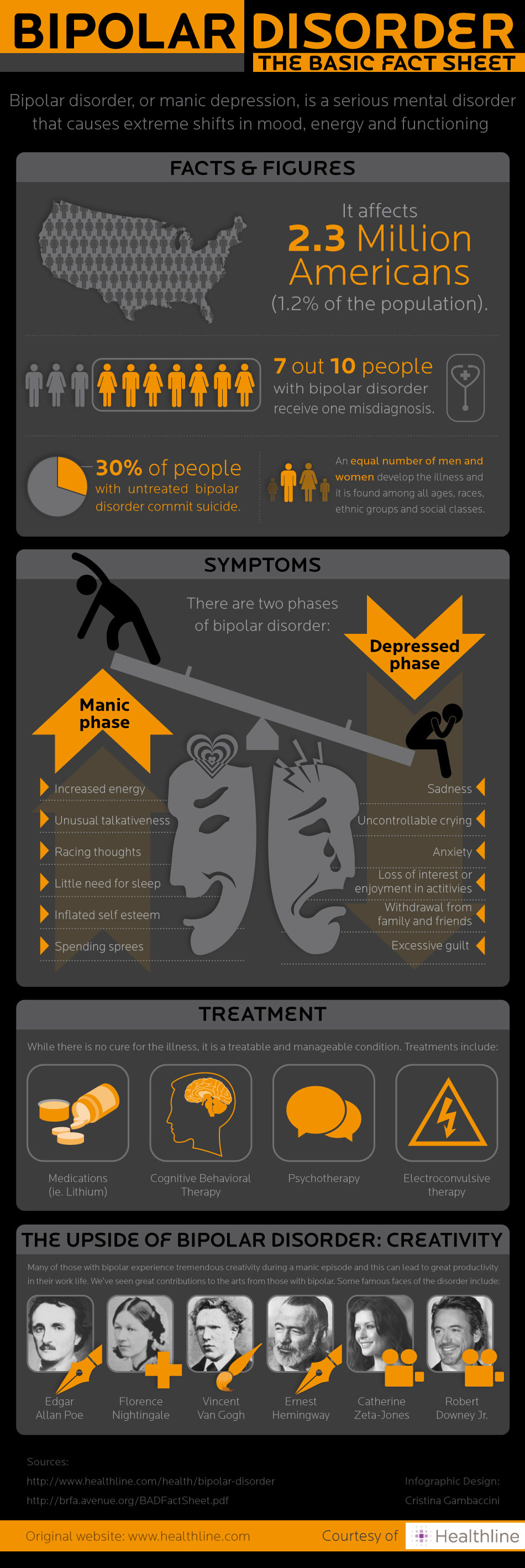
Bipolar Disorder Infographic — Healthline
Now for anyone with an interest in how undiagnosed bipolar people view the world and live their lives, this blog can be very interesting.
The breaking point for me when I finally decided there was no way I was normal and I needed help was earlier this year.
Last year I left my ex-husband whom I had married too quickly for silly reasons I had rationalized to myself,but I stayed technically married for the visa while my company promised to get me a working visa... in November, in December, next week, finally tomorrow! I was subcontracted and the subcontracting company was going to sponsor my visa. The company I was employed at told my immediate supervisor at the company and my agent at the subcontractor the day before we finally went to get my visa that they would not employ any foreigners for the consultant position unless they had a marriage or other permanent residency visa. Without their contract I couldn't get a visa and without a visa I couldn't work. I was denied contract renewal. So basically I was fired.
At the same time, my ex-husband and his father had been calling me, my supervisor, and my agent harassing and making threats. And my marriage visa was due to expire in two months. Of course he would not sign extension papers. So since I didn't have a job anyway, I signed the divorce papers and plunged into a deep depression.
In my last month at work, I fell in love with one of the interns, and he stayed with me throughout the depression. For the first time in my life I was in love and deeply depressed at the same time.
After two months, I got a better job. It doesn't pay as much because it's a small company, but the job is perfect for me. I should be happy right? I started cycling. Up down up down up down.
That's when I knew.
I am bipolar. Looking back, I know I was since before I came to Korea. You can read this blog as memoirs of a bipolar traveler.
Long overdue edit at the suggestion of a reader:
Bipolar Disorder Infographic — Healthline
Thursday, May 10, 2012
I'm pretty good at Korean now
Many people who come to Korea find that they can get by with just English. Korean and Japanese, which are grammatically structured almost the same, are much more difficult to learn for English speakers than, say, Latin-based languages. This is because they have absolutely nothing in common with English with the exception of traded words and a few coincidences. For example, in English we say "karaoke" and "sushi", and in Korea and Japan they have adopted words like "coffee" and "computer". One interesting coincidence is that in many languages around the world, the word for "mom" is similar. In Korean, it's "eomma". This is thought to be because the first sounds babies make tend to be incoherent ramblings with a lot of the "m" sound, which is the easiest consonant to make. Japanese is not one of those languages- "mom" is "haha".
한국에 오면 영어만 써도 살 수 있는 것을 알게 된 외국인이 많다. 영어 쓰는 나라에서 온 사람한테 라틴어 관련 된 언어보다 문법이 비슷한 한국어와 일본어가 훨씬 힘들다. 왜냐면, 영어랑 한국어의 비슷한 점은 서로 받았던 단어나 우연히 비슷한 단어 빼고 아예 없다. 예를들어 미국에서 "카라오케", "스시" 같은 일본어 단어를 쓰고 한국하고 일본에서는 영어에서 온 "커피", "컴퓨터" 같은 단어를 많이 쓰인다. 새계에 많은 언어로 "엄마"라는 단어가 이상하게 아주 비슷하다. 영어로는 "맘"이다. 아기들의 젓말이 대부분 그냥 의미 없는 소리 이고 그소리 중에 미음 발음이 만들기 쉬워서 많이 나온다고 생각이 있다. 일본어로는 오히려 "하하"라고 한다.
Anyway, I brought this up because I don't want to sound like I think English speakers who come here and don't learn Korean are idiots. If languages just aren't your thing, Korean and Japanese are just about impossible to learn. Fortunately for me, languages are my thing. I enjoy learning them and linking them to the culture as a whole. For example, Korean culture is traditionally communalistic, meaning that the whole is more important than the individual (as opposed to Western individualistic culture). I think this is related to the fact that the subject is optional and often omitted in Korean sentences, whereas it is mandatory in English sentences (with the exception of the command form). Languages are a hobby of mine. So it's no wonder that after 3 years in Korea I've reached a level of fluency which allows me to participate naturally in social settings and even understand about 80% of TV. Although I don't really watch TV much.
하여튼 그 말 하는 이유가 한국어 안배우는 한국에서 사는 외국인이 바보라고 말 하고 싶지 않다. 언어 재능이 타고났지 않았으면 한국어와 일본어 배우는것이 거의 불가능하다. 나는 해운이 언어 재능이 타고났다. 언어를 배우고 전체 문화랑 어떤 관련 인지 생각하기 좋아한다. 예를들어 한국은 전통적으로 공동체주의의 사회라고 개인보다 대형이 중요하는 문화가 있다 (반대는 미국같이 개인주의의 사회). 한국어 문장에 주어를 필요하지 않고 보통 지워도 돼는데 영어 무법으로는 주어 지우면 안됀다. 나한테 언어가 취미다. 그래서 당연히 3년동안 한국에서 살면서 편하게 한국인과 소통도 되고 티비 보면 80%정도 이해할 수 있는 수준으로 늘었다. 티비 많이 안보는데.
Rather than just tell you my Korean has improved, I have translated this entire post and if you also know Korean you will see that I'm not just faking or pressing "translate" in Google Translate and then copy-pasting.
그냥 한구어 실력이 늘었다고 말하는것보다 보여주는것이 더 큰 의미 있으니 이 포스트 다 직접 번역을 했다. 본인도 한국어를 할 수 있으면 거짓말 치거나 구글번역에 "번역하기" 늘어서 봍어넣기만 하는 것이 아닌 사실을 알겠다. ~영어로는 안썼지만, 여기 실수 많잖아요. 아직 많이 모른다는 느낌이 들어서 자랑하고 있는걸로 보지마세요.
The point of this is to show that learning Korean is possible if you like it and keep at it.
이 포스트의 목표가 한국어를 좋아하고 배우려고 계속 노력하면 배우기 가능한다고 다른 외국인들한테 보여주는 것이다.
Wednesday, May 2, 2012
I don't have to explain myself
It's been about 2 years since I posted.
I got married, opened a burrito restaurant in Andong, failed, moved to Seoul and worked at Samsung C&T for 14 months, in the middle of which I left my husband; in January this year I signed the divorce papers, losing my visa and my job, had a little breakdown, blah blah blah.
Now I work at a pharmaceutical company at COEX Trade Tower in Seoul and am dating an architectural engineering major with a job waiting for him at Samsung C&T (where we met during his internship just before I got fired) next year, and I am trying to figure out how to move out of my overly expensive room in a luxury high-rise on the edge of the city.
I think that about sums it up. Now instead of having a "here's my life story day by day" theme for this blog, I'm just gonna post whatever the hell I wanna post.
Nice to see you all again.
Also, I appreciate the emails from strangers with questions about Korea, but I request that you do not add me as a friend on Facebook because I don't actually know you, and then I end up wondering months later, "who is this person?" and that's just awkward for everyone.
Subscribe to:
Posts (Atom)